AWS shipped hundreds of updates in March 2026. Most of them will never affect your day-to-day work. Here are the ones that will.
Aurora PostgreSQL joins the free tier with express configuration
This is the biggest practical change for teams building on AWS this month. Aurora PostgreSQL Serverless is now available on the AWS Free Tier with up to 4 Aurora Capacity Units (ACUs) and 1 GiB of storage per cluster. More importantly, AWS introduced “express configuration” - a streamlined creation flow that spins up an Aurora PostgreSQL serverless cluster in seconds, without requiring a VPC.
That last part is significant. Previously, standing up Aurora meant configuring a VPC, subnets, security groups, and parameter groups before you could write your first query. Express configuration removes all of that for development and prototyping. The cluster includes an internet access gateway for secure connections from your development tools - no VPN or Direct Connect required.
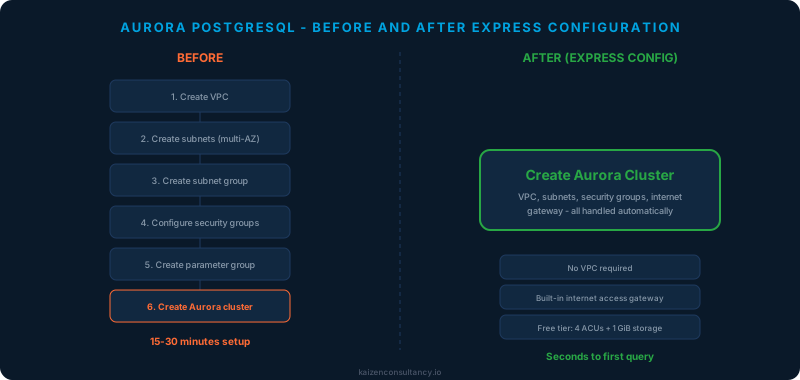
For infrastructure teams, this changes the conversation around database selection for new projects. Aurora was always the better database, but the setup overhead pushed teams towards standard RDS PostgreSQL for smaller workloads. That friction is now gone. If you are starting a new project and debating between RDS PostgreSQL and Aurora, the free tier and express configuration make Aurora the obvious default for development environments.
The Terraform AWS provider does not yet support express configuration at the time of writing. Watch for updates in the aws_rds_cluster resource.
Route 53 Global Resolver reaches general availability
Route 53 Global Resolver went GA across 30 AWS regions in March, supporting both IPv4 and IPv6 DNS query traffic. This is an internet-reachable anycast DNS resolver that provides secure DNS resolution for authorised clients from anywhere - not just from within a VPC.
Why this matters: until now, Route 53 Resolver was VPC-bound. If you had on-premises workloads or remote offices that needed to resolve private hosted zones, you had to set up Resolver endpoints in your VPC and configure forwarding rules. Global Resolver simplifies this significantly for hybrid environments.
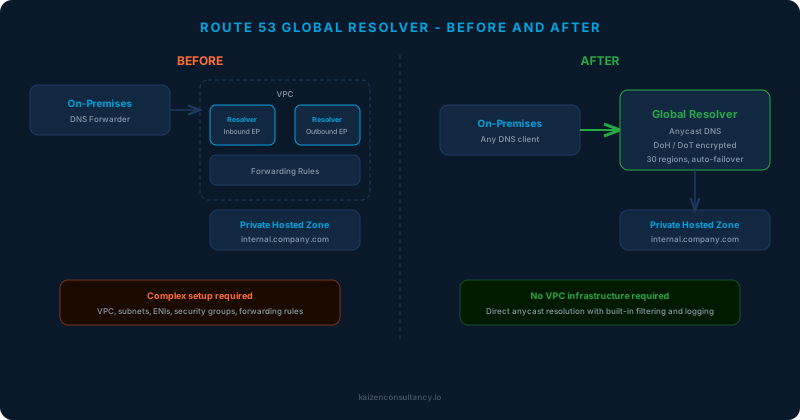
The service includes built-in DNS traffic filtering, support for encrypted queries (DNS over HTTPS and DNS over TLS), and centralised logging. For teams managing hybrid cloud environments with on-premises connectivity, this removes a meaningful amount of networking complexity.
If you are currently running Route 53 Resolver endpoints purely for on-premises DNS resolution, evaluate whether Global Resolver can replace them. Fewer endpoints means lower cost and less infrastructure to manage.
CloudWatch Application Signals adds SLO tooling
CloudWatch Application Signals now includes three new capabilities for Service Level Objectives: SLO Recommendations, Service-Level SLOs, and SLO Performance Reports. This is AWS making it easier to adopt SLO-based reliability practices without third-party tooling.
SLO Recommendations analyses your application’s historical performance and suggests appropriate SLO targets. This is genuinely useful for teams that know they should have SLOs but do not know where to set the thresholds. Starting with data-driven recommendations is far better than guessing.
Service-Level SLOs let you define objectives at the service level rather than per-endpoint, which aligns better with how most teams think about reliability. The SLO Performance Report gives you a dashboard view of how your services are tracking against their objectives over time.
For teams already using Application Signals for APM, enabling SLOs is a natural next step. For teams not yet using Application Signals, this might be the feature that tips the balance - having SLO tracking built into CloudWatch removes the need for a separate tool like Datadog or Grafana Cloud for basic reliability measurement.
S3 turns 20 - and the numbers are staggering
Amazon S3 celebrated its 20th anniversary on 14 March 2026. The milestone came with some remarkable statistics: S3 now stores over 500 trillion objects, handles more than 200 million requests per second globally, and the price per gigabyte has dropped approximately 85% since launch.
This is not a feature announcement, but it is worth noting for anyone building a business case for cloud storage. The scale and price trajectory of S3 reinforces why object storage should be the default for almost everything that is not a relational database. At roughly 2 cents per gigabyte per month for standard storage, the cost argument against S3 has effectively disappeared.
If you have not reviewed your S3 lifecycle policies recently, this is a good reminder. With Intelligent-Tiering, Glacier Instant Retrieval, and Glacier Deep Archive, there is a storage class for every access pattern. Most organisations we work with are overpaying for S3 simply because they have not configured lifecycle transitions for data that is rarely accessed.
Aurora PostgreSQL Limitless Database for horizontal scaling
While the free tier announcement gets the headlines, Aurora PostgreSQL Limitless Database is the more architecturally significant development. It enables horizontal scaling beyond the write throughput and storage limits of a single instance while maintaining transactional consistency.
This matters for teams hitting the ceiling of a single Aurora instance. Previously, scaling beyond the largest instance meant sharding at the application level - a complex and error-prone exercise. Limitless Database handles the sharding transparently, and your application connects to a single endpoint as before.
This is not relevant for most workloads today, but it changes the long-term architecture conversation. Aurora PostgreSQL can now scale to meet demands that previously required DynamoDB or a custom sharding solution. If you are designing a new system that might need to scale significantly, Aurora with Limitless Database is worth evaluating as an alternative to NoSQL.
What we are watching
A few things announced in March that are not yet GA but worth keeping an eye on:
- AWS Batch AMI visibility - Batch now shows the status of your compute environment AMIs and indicates when updates are available. Small quality-of-life improvement for teams running batch workloads, but it signals AWS investing in operational visibility for Batch.
- Agent Plugin for AWS Serverless - AWS released tooling to streamline AI-assisted development for serverless applications. Early days, but the direction is clear: AI-assisted infrastructure development is becoming a first-class AWS concern.
- OpenAI partnership - Amazon announced a $50 billion investment in OpenAI. The long-term implications for Bedrock and the broader AWS AI strategy are unclear, but this is a significant strategic shift worth watching.
That is it for March. If any of these changes affect your infrastructure and you want help evaluating the impact, book a consultation and we can work through it together.